§00 · APOD
Light Pillars and Orion over Mohe
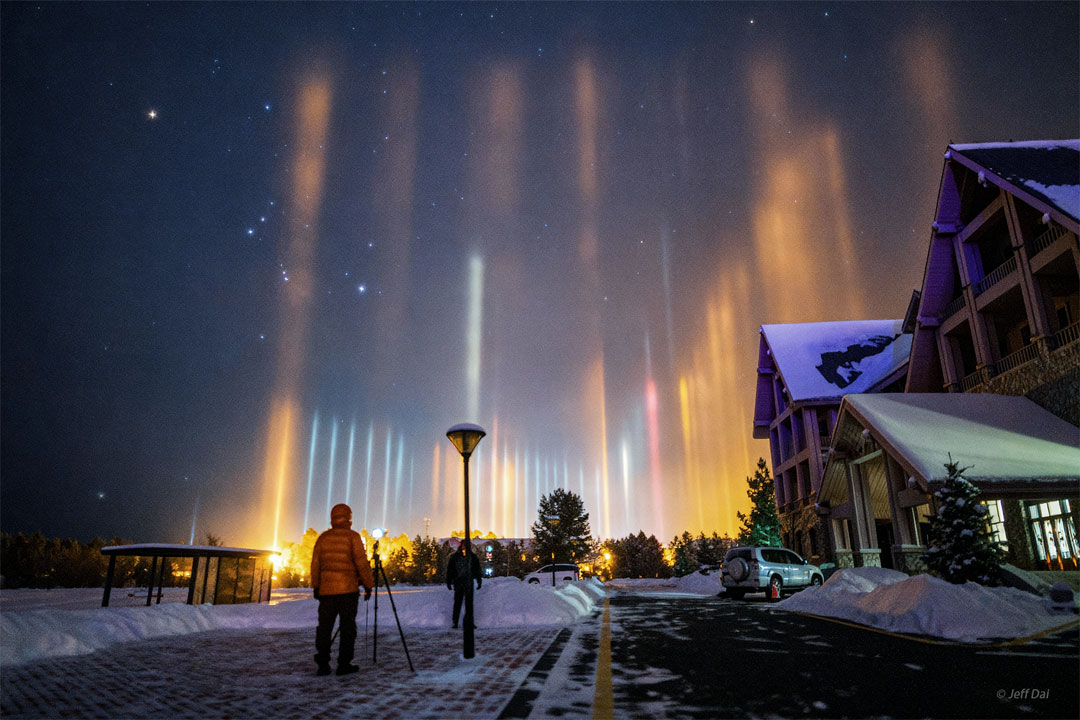
What's happening at the end of that street? Pictured here are not auroras but light pillars, a phenomenon typically much closer. In most places on Earth, a lucky viewer can see a Sun pillar, a column of light appearing to extend up from the Sun caused by flat fluttering ice-crystals reflecting sunlight from the upper atmosphere. Usually, these ice crystals evaporate before reaching the ground. During freezing temperatures, however, flat fluttering ice crystals may form near the ground and are sometimes known as a crystal fog. These small ice crystals may then reflect not the Sun but groun...
2026-03-23 · © Jeff Dai
(TWAN) ·
NASA APOD ↗
§06 · arXiv Dispatch
Research Filed Today
Preprints submitted to arXiv on March 23, 2026. Science before peer review.
01
Video generative models show emerging reasoning behaviors. It is essential to ensure that generated events remain causally consistent across frames for reliable deployment, a property we define as reasoning coherence. To bridge the gap in literature for missing reasoning coherenc...
Yu Qi, Xinyi Xu, Ziyu Guo et al. (+10)
02
Existing tampering detection benchmarks largely rely on object masks, which severely misalign with the true edit signal: many pixels inside a mask are untouched or only trivially modified, while subtle yet consequential edits outside the mask are treated as natural. We reformulat...
Xinyi Shang, Yi Tang, Jiacheng Cui et al. (+9)
03
Recent advances in diffusion models have significantly improved text-to-video generation, enabling personalized content creation with fine-grained control over both foreground and background elements. However, precise face-attribute alignment across subjects remains challenging, ...
Jiazheng Xing, Fei Du, Hangjie Yuan et al. (+7)
04
Many segmentation tasks, such as medical image segmentation or future state prediction, are inherently ambiguous, meaning that multiple predictions are equally correct. Current methods typically rely on generative models to capture this uncertainty. However, identifying the under...
Sebastian Gerard, Josephine Sullivan
05
Composed Video Retrieval (CoVR) aims to find a target video given a reference video and a textual modification. Prior work assumes the modification text fully specifies the visual changes, overlooking after-effects and implicit consequences (e.g., motion, state transitions, viewp...
Omkar Thawakar, Dmitry Demidov, Vaishnav Potlapalli et al. (+5)
06
Steering large-scale swarms in only a few control updates is challenging because real systems operate in sampled-data form: control inputs are updated intermittently and applied over finite intervals. In this regime, the natural object is not an instantaneous velocity field, but ...
Anqi Dong, Yongxin Chen, Karl H. Johansson et al. (+1)
07
Predicting future states in uncertain environments, such as wildfire spread, medical diagnosis, or autonomous driving, requires models that can consider multiple plausible outcomes. While diffusion models can effectively learn such multi-modal distributions, naively sampling from...
Sebastian Gerard, Josephine Sullivan
08
Video-driven human reaction generation aims to synthesize 3D human motions that directly react to observed video sequences, which is crucial for building human-like interactive AI systems. However, existing methods often fail to effectively leverage video inputs to steer human re...
Yuan Zhou, Yongzhi Li, Yanqi Dai et al. (+6)
Source: arXiv.org · Cornell University
§03 · The Wire
Wikipedia in Motion
500
edits recorded in the most recent sample. Most-edited topics:
ListFlightLigaCanadaTurnerDiariesTransitUniversity