§00 · APOD
Uranus's Largest Moon: Titania
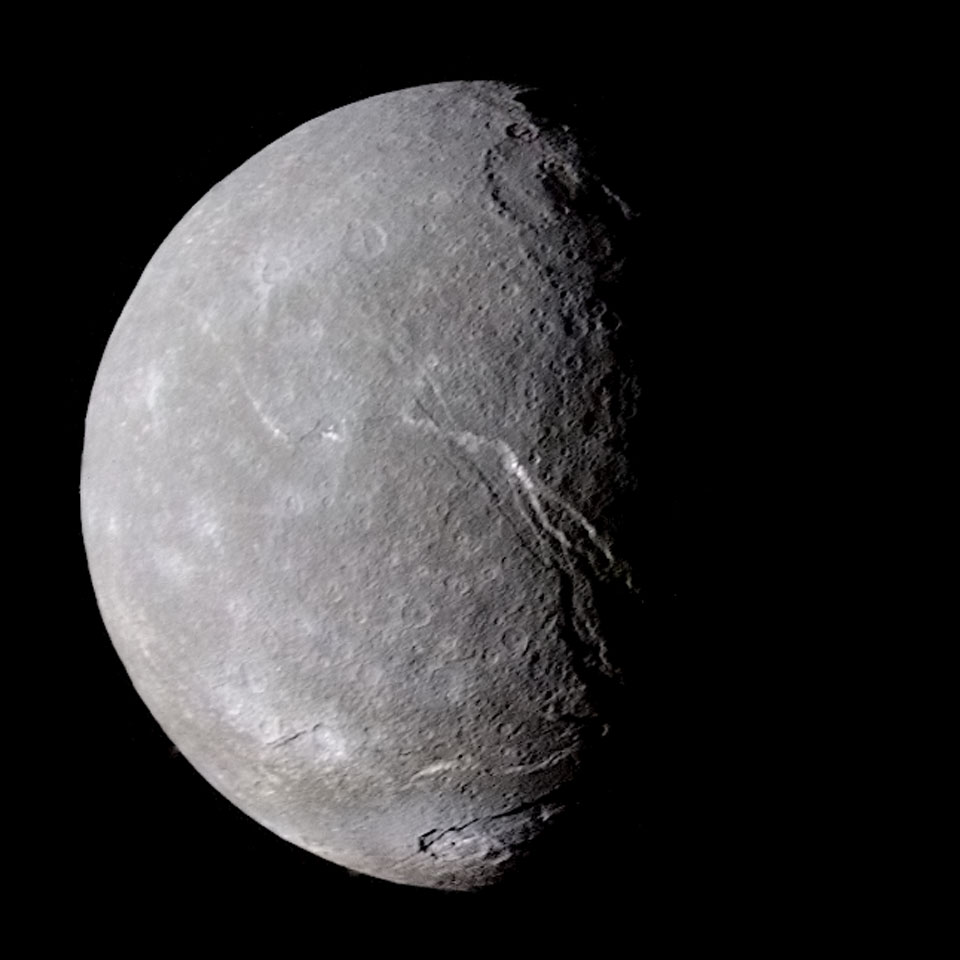
Titania's tortured terrain is a mix of canyons, cliffs, and craters. NASA's interplanetary robot spacecraft Voyager 2 passed the largest moon of Uranus in 1986 and took the feature picture. That the trenches of Titania resemble those on another moon of Uranus, Ariel, indicate that Titania underwent some violent surface event possibly related to water freezing and expanding in its distant past. Although Titania is Uranus's largest moon, it is only about half the radius of Triton - the largest moon of Uranus's sister planet Neptune, which itself is slightly smaller than Earth's Moon. Titania,...
2026-03-31 ·
NASA APOD ↗
§06 · arXiv Dispatch
Research Filed Today
Preprints submitted to arXiv on March 31, 2026. Science before peer review.
01
Recent image generation models have shown strong capabilities in generating high-fidelity and photorealistic images. However, they are fundamentally constrained by frozen internal knowledge, thus often failing on real-world scenarios that are knowledge-intensive or require up-to-...
Kaituo Feng, Manyuan Zhang, Shuang Chen et al. (+7)
02
Synthesizing human motion has advanced rapidly, yet realistic hand motion and bimanual interaction remain underexplored. Whole-body models often miss the fine-grained cues that drive dexterous behavior, finger articulation, contact timing, and inter-hand coordination, and existin...
Zimu Zhang, Yucheng Zhang, Xiyan Xu et al. (+8)
03
NVFP4 has grown increasingly popular as a 4-bit format for quantizing large language models due to its hardware support and its ability to retain useful information with relatively few bits per parameter. However, the format is not without limitations: recent work has shown that ...
Jack Cook, Hyemin S. Lee, Kathryn Le et al. (+4)
04
Similarity measures are widely used to interpret the representational geometries used by neural networks to solve tasks. Yet, because existing methods compare the extrinsic geometry of representations in state space, rather than their intrinsic geometry, they may fail to capture ...
N Alex Cayco Gajic, Arthur Pellegrino
05
Acquiring labeled datasets for 3D human mesh estimation is challenging due to depth ambiguities and the inherent difficulty of annotating 3D geometry from monocular images. Existing datasets are either real, with manually annotated 3D geometry and limited scale, or synthetic, ren...
Lorenza Prospero, Orest Kupyn, Ostap Viniavskyi et al. (+2)
06
Modern Text-to-Image (T2I) diffusion models have achieved remarkable semantic alignment, yet they often suffer from a significant lack of variety, converging on a narrow set of visual solutions for any given prompt. This typicality bias presents a challenge for creative applicati...
Omer Dahary, Benaya Koren, Daniel Garibi et al. (+1)
07
Accurate 3D understanding of human hands and objects during manipulation remains a significant challenge for egocentric computer vision. Existing hand-object interaction datasets are predominantly captured in controlled studio settings, which limits both environmental diversity a...
Patrick Rim, Kevin Harris, Braden Copple et al. (+8)
08
We present FlowIt, a novel architecture for optical flow estimation designed to robustly handle large pixel displacements. At its core, FlowIt leverages a hierarchical transformer architecture that captures extensive global context, enabling the model to effectively model long-ra...
Sadra Safadoust, Fabio Tosi, Matteo Poggi et al. (+1)
Source: arXiv.org · Cornell University