§00 · APOD
Liftoff! Returning to the Moon
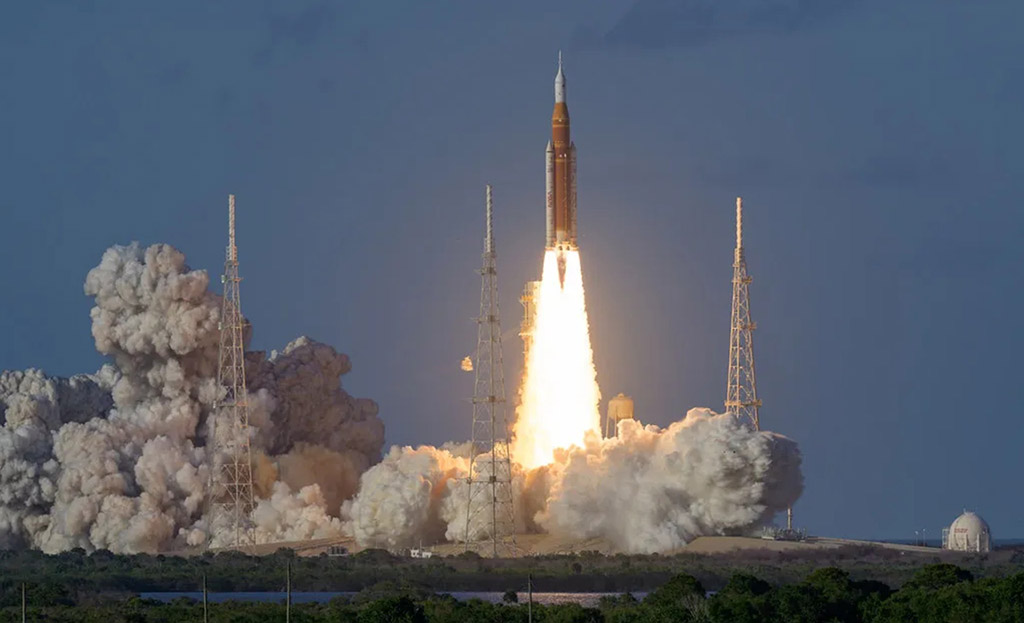
We are one small step closer to returning to the Moon. A new chapter in human exploration began yesterday when NASA's Artemis II launched aboard the Space Launch System (SLS) from Kennedy Space Center. Carrying four astronauts, the Orion spacecraft's planned lunar flyby will be the first in over half a century. This historic test flight, echoing the legacy of Apollo while pushing beyond it, will carry its crew farther from Earth than any humans since 1972, looping around the Moon before returning home. During the approximately ten-day journey, Orion's systems--from life support to navigation--...
2026-04-02 · © NASA/Bill Ingalls;
Text: Ogetay Kayali
(MTU) ·
NASA APOD ↗
§06 · arXiv Dispatch
Research Filed Today
Preprints submitted to arXiv on April 2, 2026. Science before peer review.
01
We present HippoCamp, a new benchmark designed to evaluate agents' capabilities on multimodal file management. Unlike existing agent benchmarks that focus on tasks like web interaction, tool use, or software automation in generic settings, HippoCamp evaluates agents in user-centr...
Zhe Yang, Shulin Tian, Kairui Hu et al. (+9)
02
The rise of test-time scaling has remarkably boosted the reasoning and agentic proficiency of Large Language Models (LLMs). Yet, standard Transformers struggle to scale inference-time compute efficiently, as conventional looping strategies suffer from high computational overhead ...
Yutao Sun, Li Dong, Tianzhu Ye et al. (+3)
03
Reconstructing full spatio-temporal dynamics from sparse observations in both space and time remains a central challenge in complex systems, as measurements can be spatially incomplete and can be also limited to narrow temporal windows. Yet approximating the complete spatio-tempo...
Yuxuan Bao, Xingyue Zhang, J. Nathan Kutz
04
AI weather prediction has advanced rapidly, yet no unified mathematical framework explains what determines forecast skill. Existing theory addresses specific architectural choices rather than the learning pipeline as a whole, while operational evidence from 2023-2026 demonstrates...
Piyush Garg, Diana R. Gergel, Andrew E. Shao et al. (+1)
05
As LLM agents tackle increasingly complex tasks, a critical question is whether they can maintain strategic coherence over long horizons: planning under uncertainty, learning from delayed feedback, and adapting when early mistakes compound. We introduce $\texttt{YC-Bench}$, a ben...
Muyu He, Adit Jain, Anand Kumar et al. (+4)
06
Scientific algorithm discovery is iterative: hypotheses are proposed, implemented, stress-tested, and revised. Current LLM-guided search systems accelerate proposal generation, but often under-represent scientific structure by optimizing code-only artifacts with weak correctness/...
Youssef Mroueh, Carlos Fonseca, Brian Belgodere et al. (+1)
07
We present TRACE, a mesh-guided 3DGS editing framework that achieves automated, high-fidelity scene transformation. By anchoring video diffusion with explicit 3D geometry, TRACE uniquely enables fine-grained, part-level manipulatio--such as local pose shifting or component replac...
Jiyuan Hu, Zechuan Zhang, Zongxin Yang et al. (+1)
08
We present RELISH (REgression with a Latent Iterative State Head), a novel, lightweight architecture designed for text regression with large language models. Rather than decoding numeric targets as text or aggregating multiple generated outputs, RELISH predicts scalar values dire...
Yiheng Su, Matthew Lease
Source: arXiv.org · Cornell University
§03 · The Wire
Wikipedia in Motion
500
edits recorded in the most recent sample. Most-edited topics:
ListHawkDisciplesMikeOckrentDistrictJohnSchool